
Menu
Insurance & Concrete Foundation Repair in Grand Prairie
Concrete Foundation Repair Grand Prairie
The process of understanding how homeowners’ insurance will cover your concrete foundation repair in Grand Prairie is dependent upon an understanding of the definitions of your homeowner’s policy, covered perils, and exclusions that apply to most Texas homes. Most homeowner’s insurance policies provide “dwelling” coverage that can include foundation repairs; these repairs must be caused by a sudden covered event as opposed to deteriorating over time due to natural soil movement. Because Grand Prairie has expansive clay soils, which cause foundations to move at different times and in varying degrees than other areas of Texas, the soil movement is usually excluded under most standard homeowner’s insurance policies. Therefore, understanding the difference between covered peril and maintenance-related issues is important to understand when you have a claim. Most insurance companies assess the damage to your foundation based on whether it was the result of a sudden accidental occurrence or long-term settling of your home’s foundation. To submit a successful claim to your insurance company, you should document all damage properly and be aware of the limitations of your policy in relation to your expenses associated with repairing a damaged foundation, so that you can make informed decisions regarding the cost of repairs and/or the filing of a claim. A professional assessment of your foundation will also assist in determining if the damage to your foundation is eligible for coverage through your homeowner’s insurance policy or if you need to pay for out-of-pocket repairs.
Standard Homeowner’s Insurance Coverage
Dwelling Coverage and Foundation Protection
Your homeowners policy dwelling coverage protects your home’s foundation and other structural components from damage by certain “covered perils.” A “covered peril” is a hazard or event that is specifically identified as being insured (e.g., fire, windstorm) in the policy contract. If a tree falls onto your home, causing damage to the foundation, the damage would be covered by your homeowners policy’s dwelling coverage, up to the limit of your dwelling coverage amount. The same would be true if a tornado damages your home’s foundation, provided the damage was caused by the tornado itself and not the subsequent collapse of your roof.
Most standard homeowner’s policies in Texas include foundation protection under the dwelling coverage section; however, this protection is limited to damage caused by “covered perils” listed in the policy contract. Typically, damage caused by “sudden and unexpected” events, such as a tornado or a house fire, is covered; whereas, damage caused by “gradual” events, such as normal wear and tear or poor maintenance, is typically excluded.
Covered Perils For Foundation Damage
Damage to your home’s foundation by fire is fully covered under most standard dwelling policies. In fact, this type of damage typically constitutes the largest possible claim for foundation damage. Explosions (either from gas leaks or an external source) that damage the foundation of your home are also fully covered, including any expenses associated with repairing your foundation. Vehicle impacts to your home that damage the foundation, whether from an accident involving your vehicle(s) or an accident involving someone else’s vehicle and your home, are typically covered. Vandalism or intentional damage to your home is also typically covered under most standard homeowner’s policies in the State of Texas.
Common Exclusions In Texas Policies
Soil Movement and Settling
The two most common exclusions in Texas insurance policies are shifting soil and faulty construction. As expansive clay soils are prevalent in the Grand Prairie area, foundation damage caused by settling or shifting of the soil is a frequent exclusion in many Texas insurance policies.
In general, installing piers under your home to level it is not typically covered by a standard homeowners’ policy, despite what your foundation specialist may tell you. Natural settling of the soil, soil expansion/contraction, or soil erosion typically constitute maintenance exclusions, as opposed to covered perils.
Gradual Damage and Wear
Foundation damage that develops slowly over time as a result of normal settling, aging of the structure, or lack of maintenance is consistently excluded from standard coverage. Insurers view these types of damage as avoidable by proper maintenance and regular inspections of the property. Slow plumbing leaks, long-term water seepage, and damage from tree roots, taking place over months or years, are not covered, as they are considered to be preventable maintenance issues.
Water-Related Foundation Damage
Sudden Plumbing Failures
If you have a pipe rupture in the foundation of your home and you need to locate the ruptured pipe, you probably have coverage for the damage. However, there is a catch: if you take a long time to find out about the problem, you might not be able to collect for the damage. Insurance companies distinguish between sudden failure and gradual leaks. Sudden failure from a burst pipe may be eligible for coverage if the damage occurs quickly and is reported to the insurance company promptly. It is up to the insurer to decide how much time has elapsed to allow for prompt reporting and the extent of the damage.
Flood Damage Exclusions
Flooding, including damage to your home’s foundation, is typically excluded from standard homeowners’ insurance policies and requires a separate flood insurance policy. Residents of Grand Prairie who live in proximity to Joe Pool Lake or in flood-prone areas need to obtain a separate flood policy to protect themselves from damage to their homes’ foundations resulting from rising waters or other types of flooding.
Under standard policies, damage to your home’s foundation caused by rising water, groundwater, or surface water resulting from a storm event is always excluded. Regardless of the degree of damage to your home’s foundation, this exclusion always applies.
Claim Process & Documentation
Immediate Response Requirements
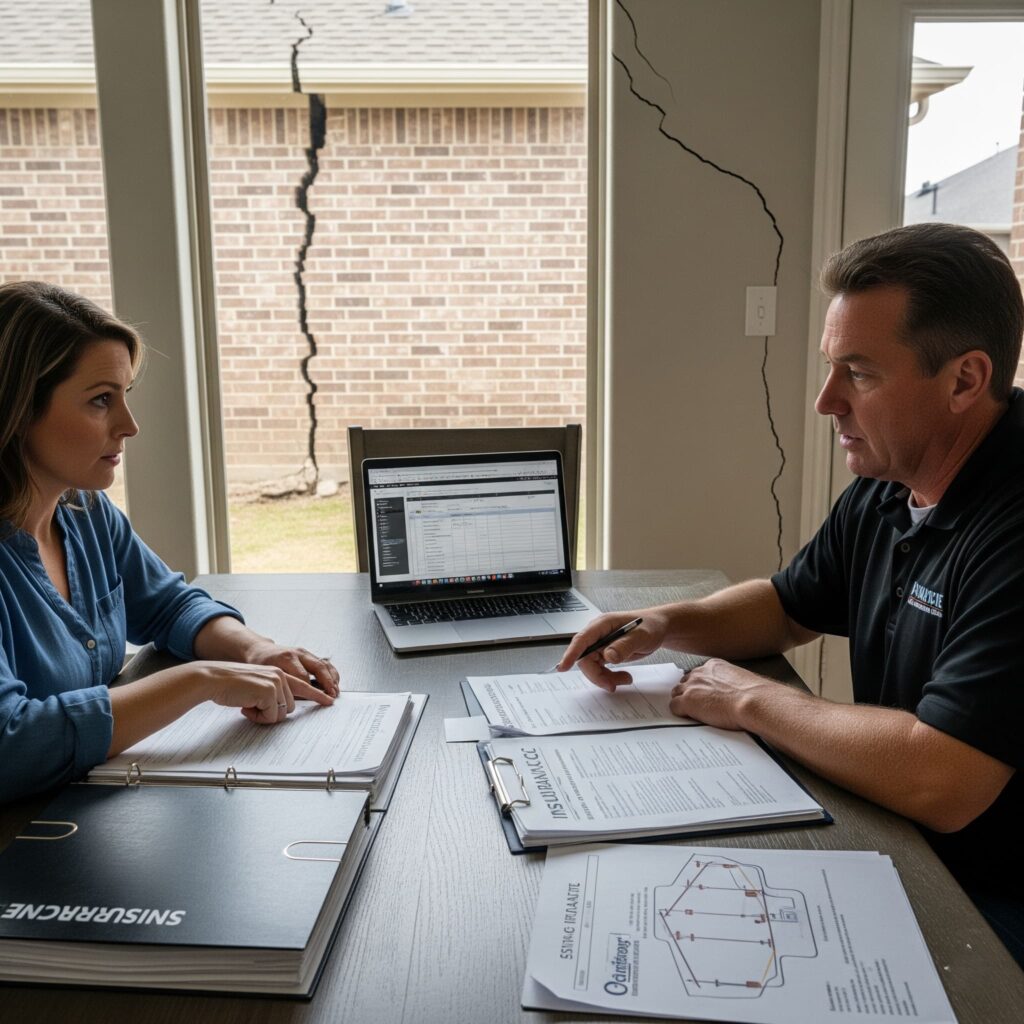
If you believe that the damage to your home’s foundation is covered by your homeowners’ insurance policy, you may want to submit a claim. Typically, your insurance company needs to be notified of a potential claim within a reasonable timeframe, as most policies contain a one-year limitation for submitting claims. Document the damage and suspected cause of damage, as well as any damage to surrounding property, with photographs and any other relevant documentation. Thorough documentation will aid in establishing a timeline and causation of damage and will assist your insurance company in evaluating your claim.
Professional Assessment & Evaluation
Your insurance company will assess damage to your home’s foundation based upon causation, degree of damage, and the provisions of your policy. In some cases, it may be necessary to hire a professional to inspect your foundation to determine whether the damage qualifies as a covered peril or if it is a policy exclusion. Obtaining independent contractor estimates to document the cost of repair of the damage to your home’s foundation is typically required by the insurance company to determine the amount of money owed to you for the damage.
Special Coverage Options
Additional Endorsements
A good insurance agent will add coverage to your homeowners policy that covers any repairs to your home after you install piers to stabilize the foundation. This endorsement will cover any plumbing damage that typically occurs after leveling your home. Foundation water damage endorsements provide coverage for any plumbing repairs that become necessary after your home’s foundation has moved or has undergone repair. These endorsements can be especially useful for residents of Grand Prairie, where foundation movement can adversely impact underground plumbing systems.
Earthquake & Earth Movement Coverage
Seismic activity can cause damage to a home’s foundation; however, the risk of earthquake damage is relatively low in the Grand Prairie area. Separate earthquake insurance policies must be purchased and premiums paid separately from your standard homeowners coverage. Sinkhole, landslide, etc., coverage may be available through special endorsements for residents living in areas with geologic risks; however, this type of coverage requires a geologic risk assessment and may not be available for all homes in Grand Prairie.
Prevention & Maintenance
Homeowner Responsibilities
Insurers expect homeowners to properly maintain their property to prevent damage to the foundation through regular inspection and maintenance. Examples of maintenance responsibilities include controlling soil moisture levels, maintaining proper drainage, and fixing small issues before they develop into larger problems. Regularly inspecting your home’s foundation will help you discover any problems early, while repair costs are still manageable and before the damage becomes so extensive that it cannot reasonably be maintained.
Soil & Moisture Management
To keep the soil around your home stable and reduce the likelihood of moisture-related damage to the foundation, regularly water the soil around your home at dawn and dusk for 30 minutes to maintain optimal moisture levels. Also, direct water away from the home with gutters, downspouts, and perimeter drains to prevent moisture accumulation around the foundation. Correct grading will ensure that water runs away from the foundation of your home instead of collecting in the vicinity of the foundation.
Tree Management
Trees growing near your home can cause damage to the foundation of your home, either through root growth or through interference with underground utility lines. Proper tree management will help reduce the likelihood of damage to your home’s foundation.
Alternative Coverage Options
Home Warranty vs. Insurance
Home warranties are designed to ensure mechanical components and appliances within your home, and typically do not cover damage to the foundation, as this is a structural element. Therefore, damage to your home’s foundation is generally not included in the coverage of a standard home warranty. There are some specialized foundation warranty programs available through construction companies and/or foundation repair contractors; however, these programs are vastly different from insurance coverage, both in terms of scope, length of coverage, and method of handling claims.
Builder’s Warranties
Typically, new construction is covered by a builder’s warranty, which insures defects in the construction of your home, including defects in the foundation, for a period of time (usually 1-10 years). Structural defects, which could include damage to the foundation, are typically covered for a shorter period of time than non-structural defects.
Financial Planning for Foundation Repairs
Understanding Repair Costs
Repair costs for the foundation of your home in Grand Prairie can vary greatly (from several thousand dollars to tens of thousands of dollars) depending on the nature and extent of the damage and the repair techniques employed. When coverage is available, it will be subject to policy deductibles, which can vary from $500 to $5,000 or more. The three most expensive types of foundation repair are pier installation, concrete leveling, and structural repairs. Understanding the potential repair costs will help you prepare financially for the repair of your home’s foundation, whether coverage is available or not.
Financing Options
If coverage is unavailable, homeowners may choose to finance the repair of their home’s foundation through various financial alternatives, including home equity loans, personal loans, or contractor financing programs. Many foundation repair companies also offer financing arrangements to allow homeowners to pay for repairs over a longer period of time. Delays in making necessary repairs to your home’s foundation will ultimately increase the total cost of repairs, as damage continues to accumulate and impacts other components of your home.
Working With Insurance Companies
Claim Filing Best Practices
For a claim to be successful, homeowners must provide thorough documentation, report the loss to the insurance company promptly, and demonstrate clearly how the damage to the foundation resulted from a covered peril. Photographs and written descriptions of the damage can help establish the extent of the damage and the causation of the damage. Maintain all communication with your insurance company and track all correspondence and the progress of your claim throughout the evaluation process. Understanding the terms and conditions of your policy and the limitations of your coverage will enable you to develop realistic expectations regarding the outcome of your claim.
Dispute Resolution
If your insurance company denies your claim for repairs to your home’s foundation, you may be able to contest the denial through your company’s internal appeals process or pursue external dispute resolution. Understanding why your claim was denied will help you determine whether your appeal has merit. You may need to hire a public adjuster or attorney for significant disputes involving high repair costs or complex damage causations. These professionals will charge fees for their services, but they may be worth considering for significant claims.
Professional Guidance & Support
Insurance Agent Consultation
Experienced insurance agents can provide guidance to homeowners regarding the specifics of their policy coverage and exclusions related to damage to the foundation of their home. Regular review of your policy will help ensure that you continue to have adequate coverage, given changes in the value of your property and changes in the risks to which your property is exposed. Shopping for the right coverage involves knowing the local risks and the available policy options. Agents who are familiar with the unique characteristics of the soil in Grand Prairie can recommend coverage enhancements that will mitigate local risks to the foundation of your home.
Foundation Repair Professionals
Professional foundation contractors are knowledgeable regarding the requirements of insurance companies and can assist in providing documentation to support valid claims when coverage exists. Their expertise can help differentiate between damage that occurred as a result of a covered peril and damage that resulted from maintenance issues that were not covered.
At Grand Prairie Concrete Pros, we work with homeowners and their insurance companies to accurately assess damage to a home’s foundation and to create estimates for the repair of that damage. With our knowledge of the soil conditions in the Grand Prairie area and our experience working with local foundation systems, we can help homeowners identify the causes of damage and determine whether those causes are eligible for insurance coverage. We can provide detailed documentation and technical expertise to help homeowners understand their options and to make informed decisions regarding the repair of damage to their home’s foundation, regardless of whether the damage is eligible for insurance coverage.
LATEST POSTS